Music, collaboration and social justice: reflections on a national research hub
For the past two years, colleagues in the Department of Music from the University of Southampton’s School of Humanities have been leading a national programme looking at how social justice can shape public engagement with music research.
The AHRC Hub for Public Engagement with Music Research was led by Dr Erin Johnson-Williams and Professor Benjamin Oliver . It was a little different from a traditional research project. Rather than carrying out their own research the Southampton team acted as a funder and facilitator, helping academics, musicians and community partners to develop projects together.
Social justice was central to the Hub from the beginning. Erin and Ben wanted it to influence not only the subjects being explored, but also the way the projects were designed and the relationships between those involved.
“We didn’t want projects where an academic did the research and then went looking for a community partner to receive it,” Erin explained. “We wanted the research questions to be set collaboratively between academics and non-academics together.”
Introducing the Hub
The team ran in-person networking events in Scotland, Wales and Northern Ireland, as well as online networking events for those who didn’t live close to Cardiff, Belfast or Glasgow, and received 84 proposals from across the UK. Eight projects were selected for mentoring, with four going on to receive funding and complete their work.
Three of these projects, which were celebrated at the Hub’s Final Project Showcase, took on very different questions. Musical Connections: Nurturing Musical Cultures in Autism Resource Bases Across the UK through Participatory Action Research worked with autistic musicians and researchers to explore more equitable approaches to music provision. “What Words Do You Not Yet Have”? Musical Storytelling, Queer Life, and the Law worked with queer communities in Bradford and Sheffield, while EQUALIZE helped young people engage with Black British music through accessible technology.
Ben was particularly struck by the care the teams brought to their work.
“The social justice lens asked people to think through every aspect of what they were doing,” he said. “It helped shape how people behaved towards each other, how they communicated and worked with participants. The work was informed by a sense of equity and care.”
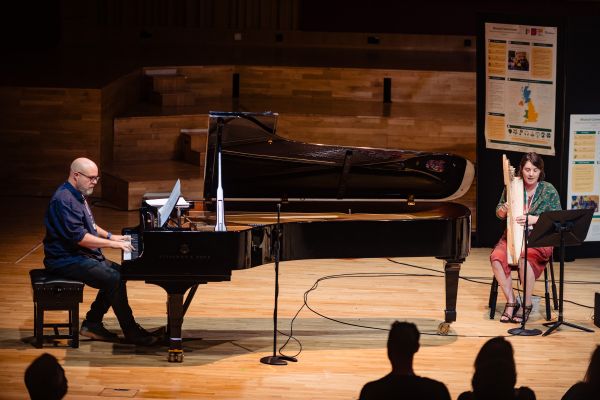
In July, around 100 people attended the final showcase at BBC Hoddinott Hall in Cardiff, including researchers, public engagement professionals and representatives from music education and the wider sector.
Rather than following a standard conference format, each project was given space to share its work in the way that felt most appropriate. This included films, performances, listening stations and displays. The day ended with everyone in the room being invited to make music together in a performance of For People From Places (2025) by composer and activist Uri Agnon.
The Hub and its projects
The funded programme has now finished, but the relationships and ideas developed through it are already feeding into new collaborations, research proposals and the work of the Centre for Music Education and Social Justice.
Erin said: “The Hub showed us what is possible when social justice is built into the structure of a project, including its funding, workload and decision-making.
“It has helped establish Southampton as a place that takes social justice and public engagement with music research seriously.”
Ben added: “The experience reaches much further than running the Hub itself. It feeds into what we do as researchers and educators, within our department and across the University.”