University of Southampton receives £1.2 million to unlock airborne atmospheric sensing for more efficient high-altitude flight
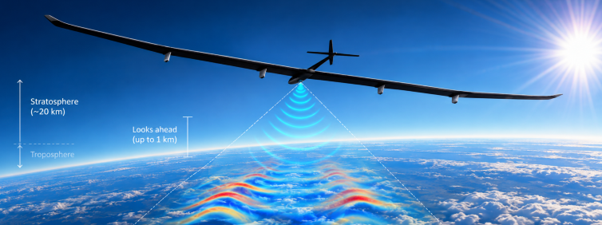
Image generated by AI
Researchers at the University of Southampton have received £1.2 million to develop technology that could help high-altitude aircraft detect atmospheric conditions ahead and use favourable winds to fly more efficiently and for longer.
The project, led by researchers in the School of Electronics and Computer Science and delivered with industry partner Saqqara Aerospace, will develop μSODAR: a compact airborne acoustic sensing system for real-time atmospheric mapping. The award forms part of the Advanced Research + Invention Agency’s (ARIA) Enduring Atmospheric Platforms programme.
Supporting persistent high-altitude flight
Backed by £70 million over three and a half years, ARIA’s programme is funding 18 teams to develop technologies that could enable High Altitude Pseudo-Satellites (HAPS) to operate reliably and cost-effectively in the stratosphere. These aircraft could provide a new layer of communications infrastructure between Earth and space, helping to extend connectivity to underserved regions.
The programme’s defining challenge is to suspend and power a communications payload in the stratosphere above the UK continuously for one week.
Unlike satellites, HAPS operate within the atmosphere and could offer lower latency, greater flexibility and potentially lower costs. Remaining airborne for long periods, however, requires aircraft to use energy carefully and respond intelligently to changing conditions.
Listening to the air ahead
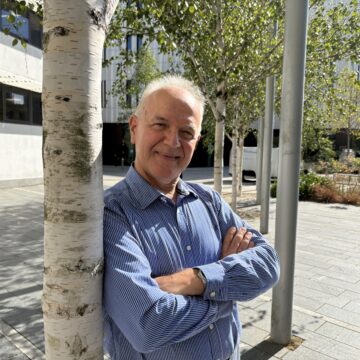
Dr Bahareh Zaghari and Professor Nick Harris will work closely with Saqqara Aerospace to design and test μSODAR, taking it from laboratory development towards airborne demonstrations. The system will use acoustic signals to detect vertical airflow, thermals, wind and turbulence ahead of an aircraft.
Dr Zaghari, the project’s principal investigator, said:
“We are delighted to have been selected as a Technology Creator. Our project is developing a new way for aircraft to sense and understand the atmosphere ahead of them.
“Conventional SODAR systems are stationary, bulky and energy-intensive. μSODAR aims to transform this concept into a low-cost, lightweight and low-power airborne system.
“By analysing acoustic returns on board, we hope to turn atmospheric measurements into useful information for energy-aware flight and navigation. The longer-term ambition is to help high-altitude aircraft identify and use favourable conditions, extending endurance beyond what can be achieved using onboard energy alone.”
From the laboratory to the stratosphere
The team will develop and miniaturise the sensing hardware, signal processing, decision-making methods and low-power electronics. Flight-testing and validation partners Limosaero and Radical will help move the technology from controlled laboratory experiments into real airborne environments and, ultimately, towards high-altitude testing.
The technology could also have wider applications, including turbulence detection for advanced air mobility, digital weather monitoring at vertiports and heliports, wind measurement for renewable energy, and next-generation aircraft sensing.