Celebrating success:
Dr Amanda Jane
Blatch-Jones on
completing a PhD
by Published Work
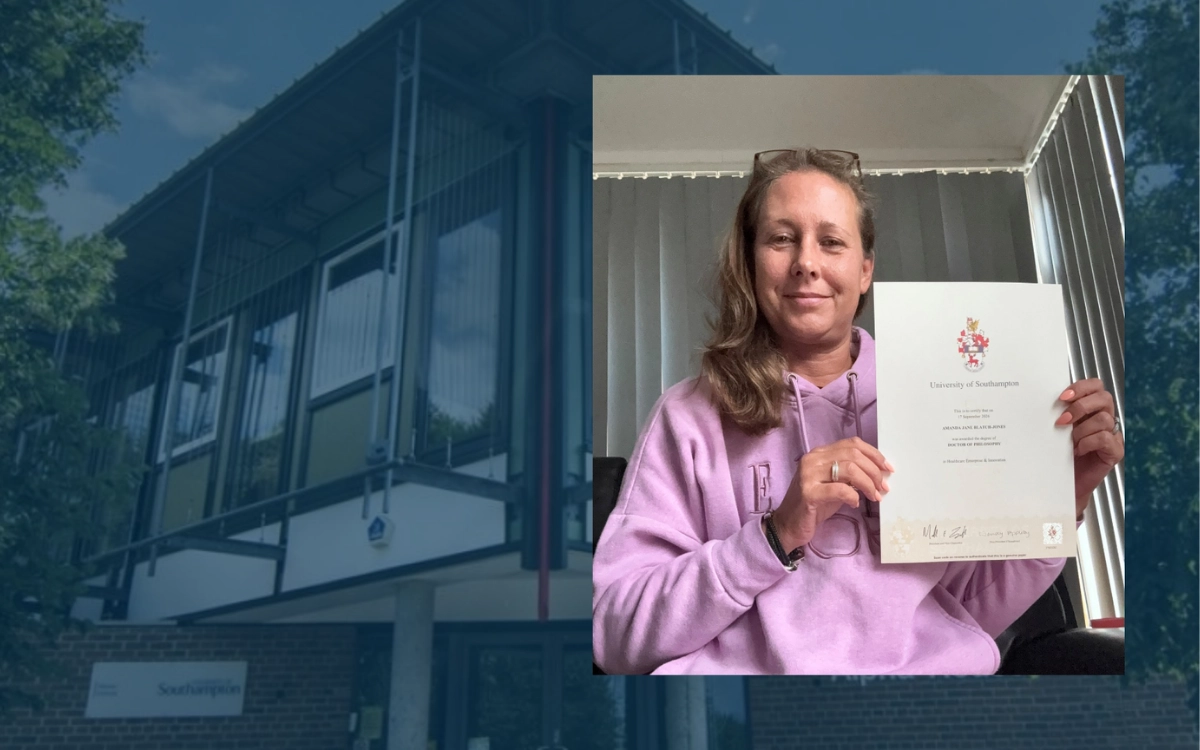
Congratulations to Dr Amanda Jane Blatch-Jones, who becomes only the second person in the School of Healthcare Enterprise and Innovation to complete a PhD by Published Work.
We sat down with Amanda to talk about her fantastic achievement, her experience of completing a PhD via this method and what advice she would offer someone who is contemplating undertaking a PhD by Published Work.
Congratulations, Amanda. What was your PhD about?
Thank you. It took me a while to get there, but the main thread that goes through it is around digital innovation and how that operates across the key stages of the research pathway. So that’s research practise in its entirety.
I used Research on Research as a methodological approach and a conceptual lens on how digital innovation is being practised and being used across different stages of the research pathway.
Why did you choose the PhD by published work route rather than a traditional PhD?
Mainly because of time and life work balance. Maintaining a life outside of work is really important to me and undertaking a traditional PhD would have required a significant commitment over several years, which simply isn’t realistic alongside my personal life.
A PhD by Published Work provided an alternative route for me, recognising and synthesising work already published. For me, it was an opportunity to gain doctoral recognition for what I had contributed to the field of Research on Research, rather than picking up a standalone research project and writing a thesis on it.
When did you realise your existing work could form a PhD?
Over the last five years, I’ve had several conversations with my line managers who kept saying “you know this option is available to you”, so the idea was always there in the background. It was really a case of waiting until the right time and deciding it was something I wanted to do.
Most of my research over the last 17 years has been in Research on Research, and most of my publications sit within that area. But the challenge has always been because we do Research on Research from very different aspects – it’s not just about peer review, funding or one specific aspect of the research process – it’s across the whole research pathway.
So, I suppose my main challenge at the beginning was what was that golden thread? What story am I going to tell in 12,000 words, linking four to six publications together? I knew what I wanted to do, but I couldn’t immediately see how to bring it together into a coherent narrative (the golden thread). And it wasn’t a case of having a small number of articles to choose from. I’ve published over 20 articles in the field of Research on Research. The real challenge was deciding which publications would best support the story I wanted to tell, which took a lot more thought than people might expect.
What surprised you most about the PhD by Publication process?
Most of the guidance is geared towards the traditional PhD route, so it took a while to work out how the PhD by Published Work process actually worked. Because it’s still relatively new, there were quite a few logistical challenges and a lot of back and forth as everyone was learning the process together. That could be frustrating at times, but in hindsight, it was also a real learning opportunity, and it’s encouraging to see the university doing more of these so the process will become much smoother for future candidates.
But I’m incredibly grateful for the support of my mentor, Professor Jo Lord, who had experience of the PhD by Published Work route and understood both the process and its expectations. Her guidance was invaluable. Importantly, she doesn’t work within the specific subject area of my PhD, which showed me that a mentor does not necessarily need to be an expert in your field. Despite the logistical challenges, having someone who understands the route can help you interpret what is expected and can provide perspective when the process feels unclear.
Did the perception of your own research change during the process?
Not really. I started out thinking the golden thread running through my work was around stakeholders, but like most people, I had a bit of a wobble along the way.
Professor Cheryl Metcalf and I went through my papers together, and she pointed out that there was actually a really strong digital theme running across them. That was the moment when the jigsaw pieces fell into place. I suddenly realised there was a much clearer narrative than I’d first thought, and it changed the direction of my narrative and made it much easier to write.
I originally wanted to focus on Research on Research, but it became apparent that there was a much bigger story to tell – one that connected my publications in ways I hadn’t fully appreciated before. Fitting that story into 12,000 words, whilst showing how the papers connected across different points in time was still a challenge.
What would you say to someone who doesn’t think their publications are “PhD-worthy”?
I would say that’s nonsense. If you’ve been published, it’s already been peer reviewed. It’s already gone through the journal process, which is, as every researcher knows, very hard. If it’s published, it means it’s worthy.
I’ve had conversations with people and they’re reticent because they don’t have many papers. But you only really need three or four. Initially I was going to do six, but I cut it down to four due to the word restriction.
What advice would you give to colleagues considering a PhD by Publication?
The first thing I would do is to see whether you can get some agreed study leave by your line manager, as having their support is critical. Having protected time to focus on the writing makes a huge difference.
Although you have a year to complete it, the time goes by much more quickly than you expect once you factor in the formatting, references and submission process, so it’s worth having everything ready before you start. I’d also recommend talking to as many people as possible in the area your PhD is in, asking colleagues to read your work, challenge your thinking and ask you questions. I didn’t do formal mock Vivas, but having lots of informal conversations about my research really helped me refine my ideas. Being realistic about how to manage your time is critical, as there are more administrative tasks than you would expect.
How does it feel to have completed your PhD?
It took a couple of days to sink in, but my family were like “we’ve got a doctor in the house,” so it was more of a personal achievement than anything else!
In all seriousness, completing my PhD feels like all the work I’ve done over the years has been recognised. I was incredibly nervous going into the Viva because you always hear horror stories, but it turned out to be a really positive experience. The examiners were genuinely interested in my research, particularly one of my papers, and it was incredibly rewarding to hear them recognise its originality and suggest there was even more that could come from it. Having external experts acknowledge the value of my work was a wonderful way to finish this journey.
Thanks Amanda, and congratulations again!
Dr Amanda Jane Blatch-Jones is a Senior Research Fellow in the School of Healthcare Enterprise and Innovation. You can read her thesis, Shaping the future of research practice: leveraging digital innovation and research on research as pathways to transformative and systemic change, in the University of Southampton Institutional Repository.